The Case of Keiko Yamada, Larry Clark, Carl Fischer Music and AI
With the rollback of DEI efforts by the Trump administration, I thought it would be timely to revisit the case of Keiko Yamada, a.k.a. Larry Clark, which attracted attention among music educators back in 2019. Using AI as my assistant, I gathered information online and came away with a different perspective this time, surprising even myself: perhaps Carl Fischer Music could have continued to distribute the compositions under Mr. Clark’s name.
[Updated 4/28/2026: please also see my recent post Keiko Yamada Controversy: 10 Years Later, looking back at the events from a 2026 perspective and the serious issue of forever digital footprints we must deal with today.]
Background
The best resource I found online is the interview by Dr. Jennifer Jolley published in New Music USA.1 For over a decade from around 2004 to 2016, Mr. Clark, a white male composer then working for Carl Fischer Music, used the pseudonym Keiko Yamada—a Japanese woman’s name—to create Japonesque musical works, often using Japanese traditional folk songs and children’s songs as motifs.
The backlash seems to have started on social media, leading to a quick “cancellation” of Mr. Clark. Mr. Clark went on to found Excelcia Music Publishing and Keiko Yamada disappeared along with “her” works. The role of Carl Fischer Music was never discussed, although the interview article made it clear that they were fully aware of Mr. Clark’s pseudonym.
This incident could have led to a deeper discussion —about fake identity, “cancelling” works, the responsibility of the organization (Carl Fischer Music) vs. an individual, the changing times, importance of having a dialogue, etc. But it never did.
AI leads to a different perspective
It so happened that I was testing Manus AI2 and, on a whim, I asked it to look for remaining traces of composer Keiko Yamada online. After several prompts and corrections, Manus quickly found over 20 works and numerous performance videos, organizing them into a list. (For the purposes of this article, I only listed 20, but there are more.) As I fact-checked Manus’ work, I couldn’t help but notice the joy and enthusiasm of the teachers and students. For example, take a listen to what this teacher has to say about “Amadare”:

Mr. Clark often used existing Japanese folks songs as motifs, so the pieces became conduits for young students to be exposed to snippets of a different culture. Keiko Yamada’s scores travelled around the world, even to Japan. The comments under some of the YouTube video, especially for the piece “Japanese Lullaby”, underscore the effects of these compositions on the students. The performances are lovely.
Today, with changing demographics and without the instant binary right/wrong verdict of social media, perhaps we can revisit Carl Fischer Music’s actions. Even back in 2019, I was never of the opinion that these works should be taken down without adequate explanation from Carl Fischer Music. Would the outcome have been different had Mr. Clark published the works under his own name, as being “inspired by” or “based on” Japanese folk songs? Was that possible within the existing structure of music education publishing at that time? Or, was the bizarre Japanese pseudonym and gender switch necessities? Would Carl Fischer have accepted a similar submission from a Japanese or Japanese- (hyphenated) composer/arranger?
Music can be an entry point into learning about all aspects of life. We should not turn our eyes away from what makes us uncomfortable. We can talk about what it means to be inclusive today, why it’s okay for a non-Japanese composer to arrange Japanese works but not okay for someone to pose as a member of another heritage. Also that what is acceptable may change over time. The U.S. is rapidly moving toward a majority-minority nation. Many cities like New York, L.A., Houston, Chicago, San Jose, are already majority-minority.3 Gen Z will be “the last generation in the U.S. with a white majority” and will give away to a majority minority generation Alpha.4 DEI will change with the times. If Mr. Clark’s Japan-inspired works could be reintroduced with proper explanation, allowing the students to think about music (w)holistically, learning from the uncomfortable issues we so often face as we try to exist together in a divided nation, perhaps we can give students an important lesson beyond the notes on the score.
Carl Fischer
Editing to add on April 19, 2026: The works continue to be performed today. Do they generate any performance royalties? This depends on a variety of factors, but it’s safe to say that most school performances are exempt and will not require licensing.5 The works are registered at ASCAP under the names of either Larry Clark or Keiko Yamada (or both), with the publisher clearly listed as Carl Fischer LLC, screenshots below. The Keiko Yamada—Carl Fischer connection is evident. While many were quick to blame Mr. Clark, I still strongly question Carl Fischer’s role and responsibility in this controversy. Not only did Carl Fischer profit from Keiko Yamada’s works in the form of sheet music, the works could also have generated performance royalties (and may be continuing to do so). Carl Fischer is not a public company so I could not get its financial reports but RocketReach shows that its annual revenue is $7.3 million.6 (Titles registered to Mr. Clark on ASCAP can be found at this link.)


The list
Below is the list partially compiled by Manus, of compositions and arrangements by Keiko Yamada (as of April 19, 2026). All works were published by Carl Fischer Music. Following the controversy, many of these compositions were removed from publication or reissued under Larry Clark’s real name, then taken down for the final time. (Note: I am not affiliated with Manus AI or Carl Fischer. Manus AI made many errors but was very clear about the process and saved me a lot of time.) (Editing to add on January 9, 2026: Keiko Yamada’s works seem to continue being performed around the world. I have updated the list with the newest YouTube performance uploaded in 2025.)
Editing to add on April 19, 2026 that Keiko Yamada’s name as composer appears on at least one state’s suggested repertoire list. Screenshots below are from Indiana State School Music Association’s Junior/Middle/Elementary/Orchestra Required List.


Keiko Yamada/Larry Clark also appears on UIL (University Interscholastic League) 2025-2026 Prescribed Music List.

Compositions in Alphabetical Order
- Amadare (Raindrops)
- Publisher: Carl Fischer
- Publication Year: 2007
- Model/Catalog Number: YAS0044F
- Grade: Easy-Medium Easy (with optional piano)
- Description: “Amadare, Japanese for ‘raindrops,’ is a marvelous evocation of natural phenomena”
- Webpage: https://compumusic.com/carl-fischer-llc-amadare-raindrops-yas0044f-825863457-798408063450-i4721116.htm
- YouTube Performances:
- BSMS Orchestra – Amadare (Raindrops) by Keiko Yamada (Rich Copley, 4.9K views, 12 years ago)
- Amadare – Keiko Yamada (The Time Being, 5K views, 9 years ago)
- Yokosuka MS 8th Grade Strings – Amadare Raindrops by Keiko Yamada (JapanCowboy66, 29 views, 3 years ago)
- Amadare (Raindrops) keiko yamada (Scott Newell, 226 views, 7 years ago)
- Raindrops, Keiko Yamada – Troy Freshman Orchestra, 9/11/16 (John Tu, 620 views, 8 years ago)
- TMEA Region 24 Concert Orchestra (2015)
- NIST International School (2016)
- “Amadore Part I [sic]” December 14, 2025 “Middle School Winter Concert”
- “Amadore Par II [sic]” December 14, 2025 “Middle School Concert”
- Cho Cho Dances
- Publisher: Carl Fischer
- Model/Catalog Number: BAS0030
- EAN: 798408060855
- Instrumentation: Orchestra-Strings (String Orchestra)
- YouTube Performances:
- Cho Cho Dances Keiko Yamada (Hannah Mann, 102 views, 8 years ago)
- Hiyoko Dances
- Publisher: Carl Fischer
- Note: This composition was found in the YouTube playlist.
- YouTube Performances:
- Hopkins 2015 Summer Concert, Intermediate Orchestra played Hiyoko Dances by Keiko Yamada (Tawei Yang, 2.2K views, 9 years ago)
- Hotaka Sunset
- Publisher: Carl Fischer
- Publication Year: 2005
- Product ID: CF2 BAS 026
- Webpage: https://highland-music.nl/en/catalog/product/4799/keiko-yamada-hotaka-sunset.html
- YouTube Performances:
- Hotaka Sunset by Keiko Yamada (GabriellaVirredici, 8.8K views, 16 years ago)
- Hotaka Sunset by Keiko Yamada (Sam Chen, 145 views, 11 years ago)
- Hotaka Sunset by Keiko Yamada, 2013.06.06 (Cheryl C, 49 views, 9 years ago)
- Hotaka Sunset, Keiko Yamada (Corey Chernesky, 184 views, 11 years ago)
- Hotaka Sunset by Keiko Yamada (Amy Schuldt, 402 views, 11 years ago)
- Edmunds Middle School 6th Grade Orchestra (2015) – Burlington, VT
- Violin 1 Part Practice Track (2017)
- Cello Part Practice Track (2017)
- Violin 2/Viola Part Practice Track (2017)
- Concert Preparation Performance (2008)
- Hotaka Sunset performed on TikTok (2025)
- Hotaru Koi (Come, Firefly, Come)
- Publisher: Carl Fischer
- Publication Year: 2008
- Model/Catalog Number: BAS0034F
- Japanese Hoedown
- Publisher: Carl Fischer
- Publication Year: 2012
- Model/Catalog Number: YAS0112
- Grade: 2
- Description: Combines American hoedown with a Japanese-flavored pentatonic melody
- YouTube Performances:
- Japanese Hoedown – Keiko Yamada (Greg CM, 241 views, 6 years ago)
- Japanese Hoedown – Keiko Yamada (Mario Alvarado, 82 views, 6 years ago)
- Japanese Lullaby
- Publisher: Carl Fischer
- Publication Year: 2006 (based on Midwest Clinic document)
- Model/Catalog Number: YAS0040F
- Webpage: https://compumusic.com/carl-fischer-llc-japanese-lullaby-yas0040f-825861284-798408061289-i4721269.htm
- YouTube Performances:
- Japanese Lullaby (Winn Dom, 10K views, 9 years ago)
- Japanese Lullaby (Daniel Wu, 59K views, 17 years ago)
- Fremont Summer 2017 Concert Intermediate Orchestra Japanese Lullaby by Keiko Yamada (Tawei Yang, 1.2K views, 7 years ago)
- Japanese Lullaby by Keiko Yamada (Soumya Parthasarathy, 219 views, 2 years ago)
- Japanese Lullaby by Keiko Yamada (Juliana Batrankova, 61K views, 14 years ago)
- RHS String Orchestra Spring Concert (2022)
- Shattuck 7th Grade Orchestra (2018) – Winter concert
- Kazoku
- Publisher: Carl Fischer
- Koneko (Kitten)
- Publisher: Carl Fischer
- Note: This composition was found in the YouTube playlist.
- YouTube Performances:
- Yokosuka MS Beginning Strings – Koneko by Keiko Yamada (JapanCowboy66, 407 views, 2 years ago)
- ORQUESTRA ESCOLA DE ILHA SOLTEIRA 19-10-2012 – KONEKO – KEIKO YAMADA (kelly verona kellyverona, 737 views, 12 years ago)
- Kon’nichiwa
- Publisher: Carl Fischer
- Grade: 1/2
- Description: “This piece is ‘hello,’ with a smile on your face. It is meant to be simply delightful for the youngest of string students.”
- Note: This was one of the pieces specifically mentioned in the controversy about the Keiko Yamada pseudonym
- YouTube Performances:
- Kon’nichiwa, Keiko Yamada (Escuela de Música Círculo Católico de Torrent, 327 views, 6 years ago)
- Mystic Fawn
- Publisher: Carl Fischer
- Publication Year: 2013
- Model/Catalog Number: YAS125
- Price: $50.00 Set / YAS125F – $6.50 Full Score / YAS125P – $3.00 Parts
- Grade: 2
- Duration: 4:32
- YouTube Performances:
- Mystic Fawn by Keiko Yamada (Jenny Morelos, 131 views, 8 years ago)
- Mystic fawn by keiko yamada (America Sanders, 169 views, 10 years ago)
- Mystic Fawn, Keiko Yamada (orchestraGLC, 2.9K views, 11 years ago)
- Yokosuka MS Intermediate Strings – Mystic Fawn by Keiko Yamada (JapanCowboy66, 16 views, 3 years ago)
- Homestead String Orchestra at 2016 CMEA (2016)
- Ohio Music Education Association 2019 District 13 Encore Honor Orchestra – Topic (November 22, 2019)
- Rickshaw
- Publisher: Carl Fischer
- Publication Year: 2011
- Grade: 2 (with optional piano)
- Description: A lighthearted, programmatic work for young orchestra, depicting a spirited ride
- YouTube Performances:
- Yokosuka MS Advanced Strings – Rickshaw by Keiko Yamada (JapanCowboy66, 213 views, 5 years ago)
- Rickshaw – Keiko Yamada (stpierrekatie, 444 views, 9 years ago)
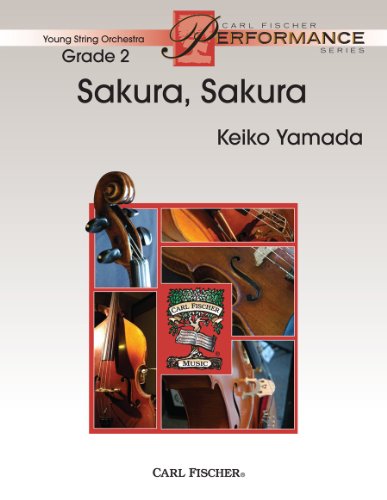
- Sakura Sakura
- Publisher: Carl Fischer
- Publication Year: 2010 (April 16)
- ISBN: 978-0825873492
- Description: An arrangement of the famous Japanese folk song also known as the Cherry Blossom Song
- Note: Probably the most famous Japanese folk song outside of Japan
- YouTube Performances:
- Sakura Sakura by Keiko Yamada UT String Project (2011)
- Yokosuka MS Advanced Strings – Sakura, Sakura by Keiko Yamada (JapanCowboy66, 600 views, 7 years ago)
- Keiko Yamada – “Sakura Sakura” – Orquestra Sinfônica de Cascavel (Joanir Produções – Cifras melódicas, 806 views, 10 years ago)
- Samurai
- Publisher: Carl Fischer
- Publication Year: 2013 (January 1)
- Model/Catalog Number: BAS0058
- ISBN: 9780825891267
- YouTube Performances:
- Samurai – Keiko Yamada – Orquestra de Alunos do Centro Suzuki Indaiatuba (Instituto Educação do Talento, 466 views, 2 years ago)
- Samurai by the CAP String Orchestra (Cathedral Arts Project, 393 views, 3 years ago)
- OAEM – Samurai ( Keiko Yamada) 2021 (Thais Pancheri, 515 views, 3 years ago)
- Samurai – Keiko Yamada – Pre Orquestra Central de Funza (24 views, May 30, 2025)
- Samurai- Keiko Yamada.Orquesta Pre-Juvenil Engativá, Bogotá, Colombia (December 17, 2025)
- Sunayama
- Publisher: Carl Fischer
- Model/Catalog Number: YAS0072
- ISBN: 0825869552
- Webpage: https://compumusic.com/carl-fischer-llc-sunayama-yas0072-825869544-798408069544-i4758750.htm
- YouTube Performances:
- Sunayama by Keiko Yamada (James Colpitts, 3.4K views, 14 years ago)
- Sunayama by Keiko Yamada and Turning Point by Robert Longfield (Jannette Rusch, 537 views, 10 years ago)
- Sunayama (John Oplinger, 49 views, 8 years ago)
- ETSBOA Jr. Orchestra Clinic 4 “Sunayama” – Keiko Yamada (jsbaby80, 42 views, 6 years ago)
- Hanks Middle School Varsity Orchestra – Sunayama by Keiko Yamada (Lothario4one, 219 views, 1 year ago)
- Sunayama : Keiko Yamada – Memorial Orchestra – 5 April 2012 (SYTube5, 3.3K views, 13 years ago)
- Prepatory Orchestra: Sunayama (February 5, 2017) (The Rivers School Conservatory, 339 views, 8 years ago)
- Audio Recording by Strings Music (2016) – Features solos
- Performance by Justin (2017) – 1.4K views
- Hopkins Intermediate Orchestra CMEA Festival (2017)
- Takeda No Komoriuta (Lullaby of Takeda)
- Publisher: Carl Fischer
- Publication Year: 2016
- Model/Catalog Number: YAS164
- Description: A well-known Japanese lullaby. The lyrics tell of a girl, Takeda, who is forced to work away from home from a young age.
- Webpage: https://www.violins.com.au/products/takeda-no-komoriuta-lullaby-of-takeda-keiko-yamada-carl-fischer-score-parts
- YouTube Performances:
- Hilliard Bradley HS Chamber Orchestra (2017) – Performance from October 18, 2016
- Tales of the Kojiki
- Publisher: Carl Fischer
- Publication Year: 2008
- Duration: 3:30
- Grade: 2
- Description: A well-written composition in E minor that meets requirements for multicultural repertoire
- Copyright notice: “This composition is protected by Copyright law. To photocopy or reproduce by any means is a violation of the law.”
- YouTube Performances:
- Tales Of The Kojiki by Keiko Yamada (Ażanïa Crÿstäl, 30K views, 9 years ago)
- Tsumasaki
- Publisher: Carl Fischer
- Publication Year: 2009
- ISBN: 9780825869297
- YouTube Performances:
- Tsumasaki (Keiko Yamada), and Zuma Breakers(Doug Spata) orchestra (The Nguyen Family, 1.8K views, 9 years ago)
- Yuki Matsuri (Japanese Snow Festival)
- Publisher: Carl Fischer
- Publication Year: 2014
- Duration: 2:59
- Grade: 2
- Description: Depicts the Japanese Snow Festival
- YouTube Performances:
- Yuki Matsuri by Keiko Yamada (Douglas Bayda, 3.1K views, 8 years ago)
- Yuki Matsuri by Keiko Yamada by Palantine High School Music Orchestra (December 2025)
- Zou-san (Little Elephant)
- Publisher: Carl Fischer
- Publication Year: 2008
- Model/Catalog Number: BAS0043
- Description: Japanese children’s folk song in G major and 3/4 time
- Webpage: https://compumusic.com/carl-fischer-llc-zou-san-little-elephant-bas0043-825866693-798408066697-i4758386.htm
- Jolley, J., Jolley, J., & Jolley, J. (2021, June 2). The curious case of Keiko Yamada. New Music USA – Supporting the Sounds of Tomorrow. We Envision a Thriving, Connected, and Equitable Ecosystem for New Music Across the United States. https://newmusicusa.org/nmbx/the-curious-case-of-keiko-yamada/ ↩︎
- Manus moved its headquarters from China to Singapore and was reportedly in the process of being acquired by Meta per its announcement in December 2025. However, in April 2026, it is being reported that China is blocking the acquisition and the two co-founders of Manus are currently prohibited from leaving China. https://www.bbc.com/news/articles/cj0v0gr2yz7o ↩︎
- Frey, W. H. (2021, October 28). 2020 Census: Big cities grew and became more diverse, especially among their youth. Brookings. https://www.brookings.edu/articles/2020-census-big-cities-grew-and-became-more-diverse-especially-among-their-youth/ ↩︎
- Helmore, E. (2023, August 9). Gen Z will be last generation with white majority in US, study finds. The Guardian. https://www.theguardian.com/us-news/2023/aug/08/gen-z-americans-white-majority-study ↩︎
- United States Copyright Law: A guide for music Educators – NAFME. (n.d.). NAfME. https://nafme.org/resource/united-states-copyright-law-a-guide-for-music-educators/ ↩︎
- Carl Fischer Music Publishing Information. (n.d.). RocketReach. https://rocketreach.co/carl-fischer-music-publishing-profile_b5c5e8e4f42e0e5d ↩︎