How Do We Find Music?
(This is Part I of the three-part series on music discovery. Part II is How Do We Find Music? (2025 version) and Part III is How Do We Find Music? (Outside of the U.S. version).)
How do we find music? Recommendations from friends? Movies? Video games? Algorithm? Music is everywhere. But when 120,000 tracks are being uploaded every day to digital streaming platforms1 and Spotify gives us access to over 100 million tracks,2 the chances of us encountering a piece of music become surprisingly low.
Yet, we find them.
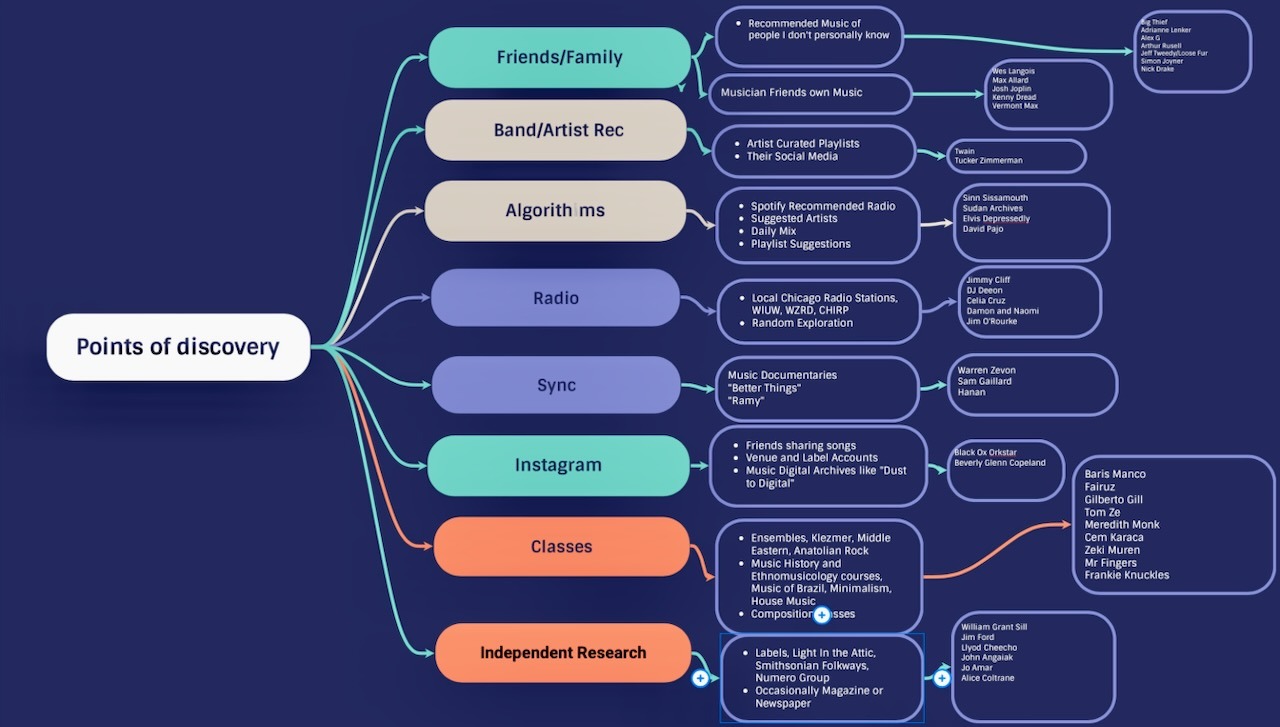
This semester at Bennington College, my class “Musical Taste and Monetization” took another deep dive into music discovery methods. The image above is a page from a project by Ruben Whitaker, recent graduate of Bennington College, who analyzed years of their playlists and made the following observation: “Friend recommendation + Algorithm seems to be a powerful phenomenon of exposure especially if the artist and sub-genre are completely new…I was surprised at the low number of artists and songs I encountered through algorithms, this highlights that peer-to-peer recommendation is strong…”
Ruben continues: “I think a lot of people listen to…music they know personally or locally because it’s more of a personal relationship. I think this aligns with the hypothesis of music being developed for social bonding. This is something to think about in terms of how to build strong musical networks and offer something that AI music or mass-produced popular tracks cannot.”
When I first designed this course back in 2021, I anticipated students to rely heavily on the Spotify algorithm. How wrong I was! Although Spotify is the main platform many use to listen to music, the ways in which students discover music were remarkably diverse and creative, with person-to-person communication and live concerts playing huge roles, that I had to completely rethink and recalibrate all I had thought I knew.
Daniel Ek recently made comments about the cost of creating content, and my class too had previously reached a similar conclusion specifically regarding digital content: anything that can be reproduced digitally ad infinitum with a click of a button skews the traditional supply and demand curve. We discussed what it means to live in a society surrounded by technologies of abundance: “New technologies continue to democratize, decentralize, and disrupt production, offering the possibility that scarcity will be a thing of the past for many industries. We call these technologies of abundance. But our economy and our legal institutions are based on scarcity.” 3
Music is so much more than digital content. Reexamining the non-digital component of music feels especially important right now. Music has been integral in every culture since the dawn of humanity, with many researchers highlighting the relationship between music and social bonding.4 In that spirit, I continue to make music and explore the opportunities of social bonding through music. The next generation already understands this. These students are creating our future. We have so much to learn from them.
[Image by Ruben Whitaker, used with permission. Ruben Whitaker is a Chicago-based songwriter and multi-instrumentalist, and a graduate of Bennington College. During college, Ruben ran a radio show called “Folkloric Geography” which showcased music from around the world. Ruben has several releases under the name “Ruben Jai” including the the album Present for You and the singles Washburn and Neighborhood Planets.]
- Stassen, M., & Stassen, M. (2023b, May 24). There are now 120,000 new tracks hitting music streaming services each day. Music Business Worldwide. https://www.musicbusinessworldwide.com/there-are-now-120000-new-tracks-hitting-music-streaming-services-each-day/
- Konstan, E. & Spotify Technology S.A. (2023). FORM 20-F. In UNITED STATES SECURITIES AND EXCHANGE COMMISSION [Report], P.35, https://s29.q4cdn.com/175625835/files/doc_financials/2023/ar/26aaaf29-7cd9-4a5d-ab1f-b06277f5f2a5.pdf
- Desai DR and Lemley MA (2023) Editorial: Scarcity, regulation, and the abundance society.
Front. Res. Metr. Anal. 7:1104460. doi: 10.3389/frma.2022.1104460 - Mehr, S. A., Krasnow, M. M., Bryant, G. A., & Hagen, E. H. (2021b). Origins of music in credible signaling. Behavioral and Brain Sciences, 44. https://doi.org/10.1017/s0140525x20000345
(This article originally was written for, and appeared on, New York Jazz Workshop blog)