How Do We Find Music? (Outside of the U.S. version)
This is the final post in the three-part series on music discovery methods. For previous posts, please visit How do we find music? and How do we find music? (2025 version).
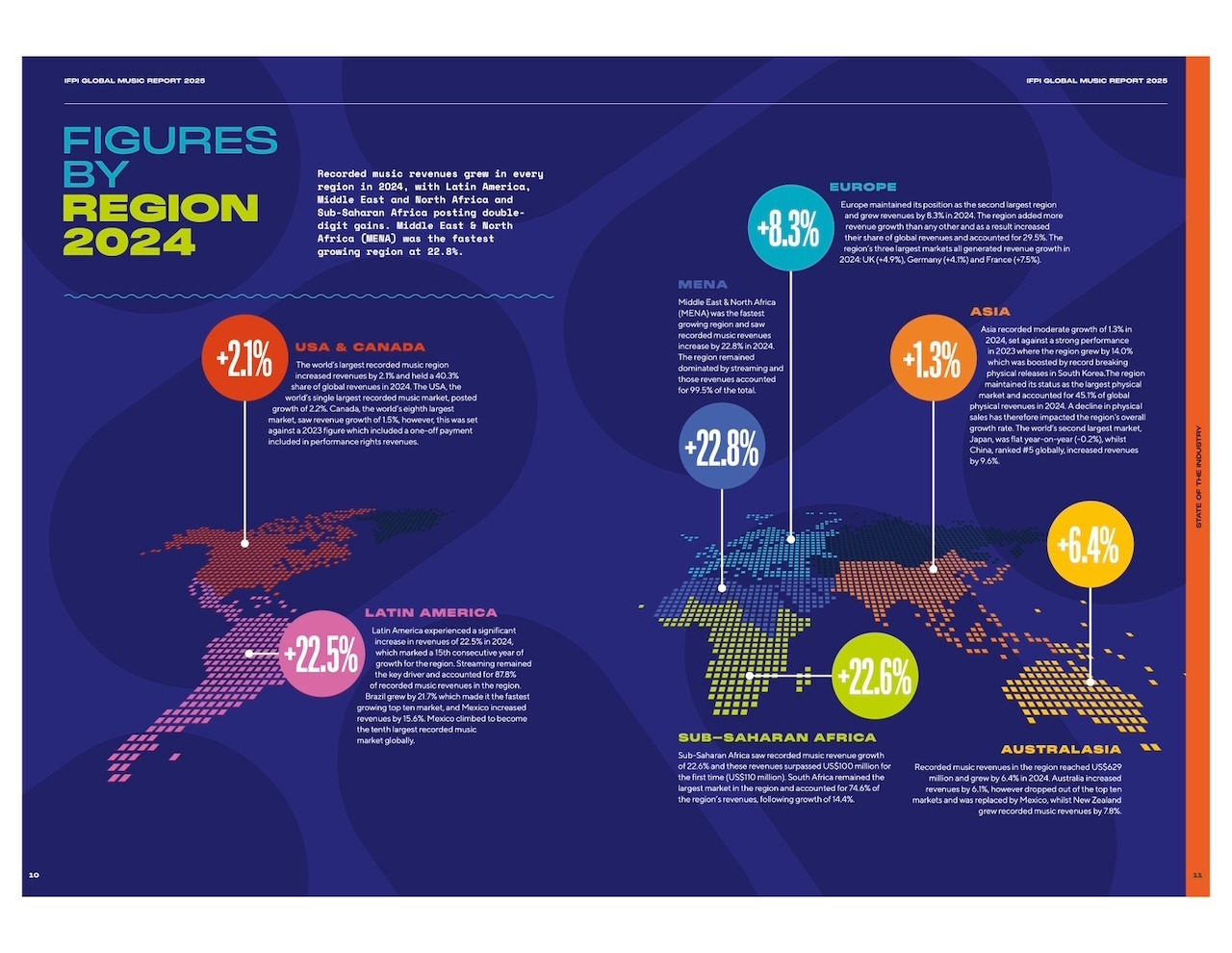
Every year in my Music Monetization class, we look at recorded music revenue growth by region. Available numbers for 2024 showed us that Latin America, Middle East and North Africa and Sub-Saharan Africa posted double-digit gains, with Middle East & North Africa (MENA) the fastest growing region at 22.8%. 1 The U.S. market is saturated. The growth is outside of the Global North and the West.
The contributions of international students every year have been invaluable in offering a different voice, balancing the narrative and giving us a global perspective. Below is a fantastic essay by a recent Bennington College graduate Andy Kongolo, from Congo, shared with permission. I learned so much from my students and cannot thank them enough.
Andy Kongolo
The Business Side of Music
Midterm Essay
Seasons of My Life Through Music
Music has been a constant thread through my life, weaving together my experiences across continents, cultures, and personal transformations. From my childhood in the Congo to my current chapter as a college student in the United States, each season has been defined by distinct sounds and exposure points that shaped my identity. This essay traces my musical journey through the artists, genres, and means of access that marked my path—from the rhythms I absorbed as a child to the tracks I create today. Music has been my mirror, reflecting my roots and rebellions; my escape, guiding me through change; and now my voice, empowering me to tell my story.
As a child in the Congo, music was ever-present, like the air I breathed, delivered through my parents’ choices. Without a personal device, I soaked up Congolese rumba, a soulful, rhythmic genre that pulsed through our home. My parents played CDs of JB Mpiana, Mbilia Bel, Tabu Ley, Koffi Olomide, Fally Ipupa, P Square, Werrason, and Tshala Muana in the living room or during car rides to school. Their vibrant melodies were the heartbeat of my early years. Occasionally, the TV or radio brought disco and pop with Boney M’s “Rasputin,” ABBA’s “Dancing Queen,” Celine Dion’s “My Heart Will Go On,” or Michael Jackson’s “Billie Jean.” I was a passive listener, absorbing these sounds without choice, yet they rooted in me a love for melody and rhythm that would echo later.
Middle school marked a rebellion, sparked by my first smartphone—a portal to independence. My exposure shifted from family to friends, who introduced me to French rap. Sexion d’Assaut’s “Désolé” and Stromae’s “Papaoutai” hooked me with their infectious beats, but soon I dove into hardcore French rap: Booba’s “Kalash,” Kaaris’ “Tchoin,” La Fouine, Gradur, Niska, Black M, Gims, and Dosseh. Friends also shared US hip-hop—Chief Keef, Migos, 2 Chainz, Lil Wayne, Gucci Mane, Drake’s “Take Care,” Young Thug, and Future—whose raw energy matched my teenage restlessness. In the Congo, accessing music was tough with spotty internet, so I traded songs via Bluetooth or downloaded from sites like Tubidy or MP3Skull, curating albums meticulously.
The pressure to fit in at school led me to bury my love for rumba, mocked as “old-fashioned.” Music became my refuge, a way to define myself. At 14, I recorded my first track, “For My Homies,” with my friend Quddus, a thrilling taste of creation that deepened my connection to rap’s rebellious spirit. This season was about claiming my own sound, even if it meant hiding parts of my past.
High school began with a tight grip on French rap—PNL’s “Le Monde ou Rien,” Alpha Wann, Ninho’s “Maman ne le sait pas,” Keblack, Damso—and US hip-hop like Drake and Kendrick Lamar’s “HUMBLE.” I downloaded tracks over slow Wi-Fi, playing albums start to finish. But in 11th grade, moving to an international school in India with students from 80 countries blew my world open. Friends introduced K-pop with BTS’s “Dope,” reggaeton with Bad Bunny’s “Safaera,” electronic music via Daft Punk’s “Get Lucky,” pop through Adele’s “Someone Like You,” and Afrobeats with Yemi Alade. Distance from home sparked nostalgia, leading me to reconnect with Ndombolo and rumba through Fally Ipupa’s “Aime-moi” and Werrason.
The school’s free Wi-Fi and YouTube Music freed me from my MP3 player on my phone, letting me explore singles and playlists instead of rigid albums. High school was a season of liberation, where I embraced a fluid musical identity shaped by a global community and my rediscovered roots.
Starting college in the US introduced Spotify, a revelation after years of makeshift access. Its endless catalog let me revisit my past: Congolese rumba from JB Mpiana and Fally Ipupa, French rap like Sexion d’Assaut, and US hip-hop classics from Wu-Tang Clan’s Enter the Wu-Tang. These sounds anchored me as I adjusted to a new country. Friends also exposed me to indie music, Chily’s fresh French rap style, and Vybz Kartel’s dancehall energy, adding new layers to my listening. College was a balance of nostalgia and cautious exploration, with Spotify playlists as my bridge between past and present.
Today, my musical exposure has turned inward—I listen almost exclusively to my own music. After years shaped by rumba, French rap, US hip-hop, K-pop, reggaeton, Ndombolo, Afrobeats, pop, electronic, indie, and dancehall, I’m creating tracks that blend these influences into something uniquely mine. My songs draw from the soulful rhythms of my childhood, the lyrical edge of my teenage years, and the global sounds of high school. Making music is my way of synthesizing every CD, Bluetooth swap, YouTube stream, and Spotify playlist into a narrative that’s wholly my own. This season is about claiming my voice, not just as a listener but as a creator.
Music has been my mirror, my rebellion, my anchor, and now my voice, weaving my past into a soundtrack for my future. Each season of my life—shaped by family, friends, internet, schoolmates, and streaming—brought new genres and artists, reflecting my growth through music.
- IFPI GLOBAL MUSIC REPORT 2025. (n.d.). https://globalmusicreport.ifpi.org/ ↩︎