Reactions to my AI-generated remixes
Thank you to the many people who sent me comments about the AI-generated remixes, available on my Soundcloud “Artifacts from the Labyrinth Remixed” playlist (streaming for free): https://soundcloud.com/kyoko-kitamura/sets/artifacts-from-the-labyrinth
The comments ranged from “AI music is bad and uninteresting” to “development is lightening fast, and AI is so powerful, we should all be aware of the situation.” The latter invariably came from those who were engaged with AI in their respective fields, did not see AI as a binary good/bad situation, knew that it was all around us and that we can help navigate the process by being aware. I am firmly in the latter camp, as were many educators and those in mentorship roles. As educators, more than ever, we need to be forever-students.
Everyone is certainly entitled to their opinions. But to educators and mentors who express views that AI (and AI music) are bad, my hope is that they can present a coherent argument which can lead to a wider discussion about how the AI-less past connects to the present, and what we can learn from our AI-less past which may help the younger generation navigate better the present and the future.
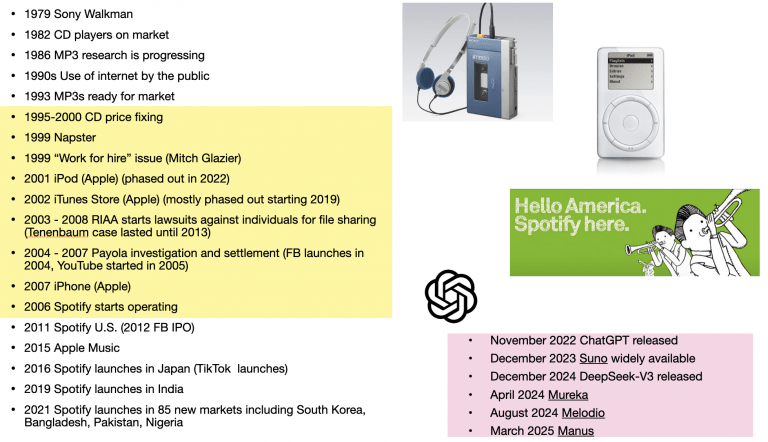
As musicians, we can hear technological development. This can be our advantage in helping the next generation. It’s worth noting that many music professionals have already openly integrated AI into their workflow, most notably Timbaland who became Suno’s strategic advisor in October 2024. Charlie Puth joined Moises in March of this year as its Chief Music Officer to develop “AI tools that amplify artists’ creativity.”[1] A recent Rolling Stone article indicates that AI-powered tools have “found a place in the studios and digital audio workstations of many of the biggest producers and songwriters in the world”[2] and I too know that this is happening. Stores have started to experiment with AI-generated background music, with documented cases in Belgium.[3] Most music professionals use AI music tools surgically to fine tune a track, e.g., stem separation to remove a sample to which they may not have rights to, just like they would any music software.
AI is powerful. Its force of disruption is still unknown. We are still in this together and we’ll have a better chance to influence the outcome, if not get a seat at the table, if we are aware.
[1] Moises. (2026, March 4). Charlie Puth joins Moises as chief music officer to shape the future of music technology. Moises. https://moises.ai/newsroom/company-milestones/charlie-puth-chief-music-officer/
[2] Brackett, N. (2026, March 25). Inside the don’t ask, don’t tell era of AI in music. Rolling Stone. https://www.rollingstone.com/music/music-features/ai-in-music-how-used-now-1235536484/
[3] Times, B. (n.d.). Musicians miss out as Belgian retailers turn to AI-generated music in stores. https://www.brusselstimes.com/1798519/musicians-miss-out-as-belgian-retailers-turn-to-ai-generated-music-in-stores