Spotify’s fake artists vs. Endel
The fantastic article on Spotify by writer Liz Pelly in Harper’s Magazine (The Ghosts in the Machine1) felt like an apt summary at the end of the year. I appreciated the nuanced approach, especially since the writer makes efforts to follow and interview current working musicians on the scene, which is so often not the case in many of the other writings I’ve seen on this subject.
Spotify’s fake artists issue was a topic I’ve been following for many years, for the courses I offered at Bennington College. I was made aware of it back in 2016 when Tim Ingham, founder and publisher of Music Business Worldwide (MBW), started the excellent reporting on the subject. The first in the series was titled SPOTIFY IS MAKING ITS OWN RECORDS… AND PUTTING THEM ON PLAYLISTS2 published on August 31, 2016. I believe this was the first time the general public was made aware of this issue on a wider scale. MBW followed up with a story about Spotify’s denial – and rebuttal to that denial including a rough estimate of the $$$ these tracks by fake artists could rack up (July 9, 2017 SPOTIFY DENIES IT’S PLAYLISTING FAKE ARTISTS. SO WHY ARE ALL THESE FAKE ARTISTS ON ITS PLAYLISTS?3), continuing with a report on a possible effort by Universal Music Group (UMG) to ameliorate their situation (August 2, 2018 FAKE ARTISTS STILL DOMINATE SPOTIFY ‘CHILL’ PLAYLISTS. NOW UNIVERSAL IS FIGHTING BACK… WITH APPLE MUSIC.4) and a story about one of the production companies allegedly supplying this type of music to Spotify (March 28, 2022 REMEMBER SPOTIFY’S FAKE ARTISTS? THEY’RE STILL GOING STRONG – AND STILL ATTRACTING SCANDAL.5) along with a response from a well-connected reader.6 This year, MBW followed up with a portrait of one of the composers7 of this type of music.
If you haven’t followed MBW’s reporting, I highly recommend chronologically reading the above articles to get a sense of how the story developed. I also appreciate that MBW disaggregates the problems and reports separately on Spotify stock price/cash out8, a related but fundamentally different issue. Conflating the two only adds to the muddied landscape, fueling moral outrage about the wealth gap and generating a certain kind of interest, which may not be a bad thing, but ultimately putting the focus on the polarization and bringing us no closer to a solution.
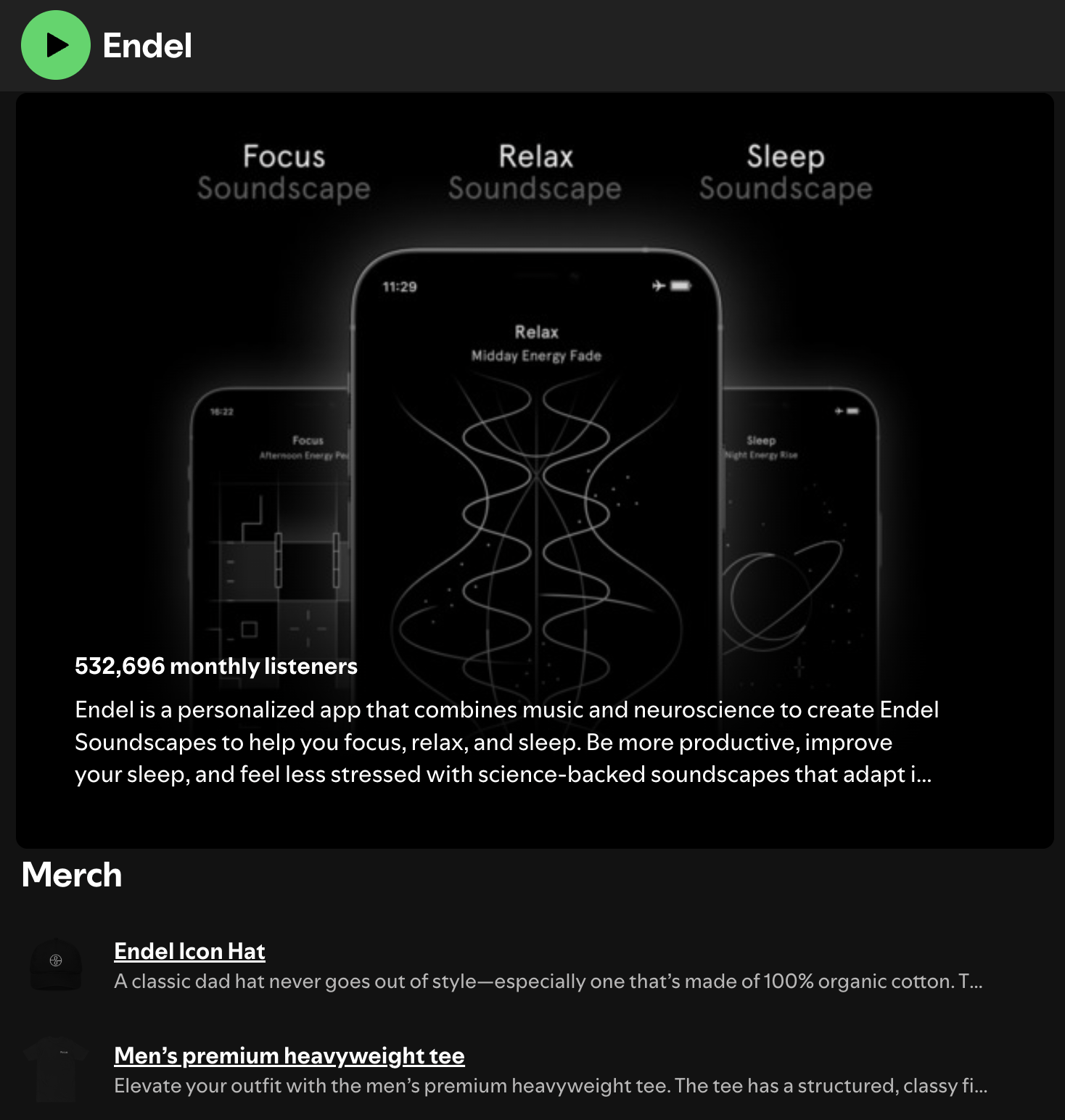
Spotify is hardly the only platform offering functional music playlists. There is one company which offers ONLY that: Endel, the creator of AI-generated music which, according to its 2022 press release, is “a sound wellness company” with an “award-winning patented technology” which supposedly “creates science-backed, functional soundscapes that help people relax, focus, and sleep better.” As evidence of their effectiveness, Endel often cites the 2021 research paper9, which used technology developed by its collaborator Arctop Inc., research funded by both Endel and Arctop, with the support of UMG, Warner and Sony. Endel has partnered with UMG and Warner, and has also released through AWAL which is now a subsidiary of Sony10. As musicologist Ryan Blakeley writes in AMS Musicology Now’s article “Welcome to the Sound Wellness Revolution”: Endel’s AI-Generated Soundscapes and the Commodification of Passive Listening11, an overview of issues surrounding Endel, there are very clear financial incentives to offering functional music. Endel now has its own set of merch too, like the Endel Icon Hat described as “the classic dad hat never goes out of style”.
And here we see the outline: a land grab for the digital functional music space – by platforms, major labels, artists and AI-generated music creators. Currently most visible are the Spotify and “fake” artists, while the work by major labels with their collaborators like Endel remains less conspicuous.
So, what are the real issues here? Is it that the contributing human artists are using “fake” names? What if they don’t want to use their real names? Is it that the public is being duped by fake artists? But artists have always had the tradition of using pen names. Or is it that the human artists have entered into a “work for hire” agreement? That too has always been an option for us artists. Is it that the amount paid to artists is not commensurate with Spotify’s profits? Spotify has never turned an annual profit as of the writing of this post (12/26/2024) although this year may be different. 70%+ of its revenue has been paid back to rights holders. If there is a problem here at all, it would be between the rights holders and the artists.
Yet, there is a fundamental inequality which needs to be addressed. Monopsony and oligopsony have unfortunately become par for the course. Everyone is pursuing a share of their listening time for profit and artists are losing out.
Despite all of the above attracting attention, it’s important to remember that we are actually dealing with a small section of music: digital music which is not performed live. It’s easy to forget that so much music exists outside of this paradigm. If we look back on the history of music, the recent research on why it exists and its possible roles, and how music has been participatory for most of human history, we can perhaps find alternative paths for the next generation musicians who desire to work in both the digital and acoustic world, creating music for sync licensing as well as cultivating spaces where artists and audiences can mingle over live music. There are so many paths.
When working musicians are kept out of the conversation, the picture becomes a version of the simplified binary argument: is Spotify good or bad? The situation is so much more complex than that. We creators are not a monolith. Our relationship to Spotify runs the spectrum, depending on where we are on that particular commercial totem pole. As a former reporter who still has a foot in media, I am always perplexed as to why musicians’ viewpoints are so often left out of the coverage surrounding the music industry. Liz Pelly’s writing was all the more impactful to me because of the lengths the writer went to capture the voices of the creators. I look forward to reading the book.
This will be posted on Bluesky and Mastodon. Happy holidays everyone!
- Pelly, L. (2024, December 18). The Ghosts in the Machine. Harper’s Magazine. https://harpers.org/archive/2025/01/the-ghosts-in-the-machine-liz-pelly-spotify-musicians/ ↩︎
- Ingham, T., & Ingham, T. (2017b, July 8). Spotify is making its own records… and putting them on playlists. Music Business Worldwide. https://www.musicbusinessworldwide.com/spotify-is-creating-its-own-recordings-and-putting-them-on-playlists/ ↩︎
- Ingham, T., & Ingham, T. (2017d, July 10). Spotify denies it’s playlisting fake artists. So why are all these fake artists on its playlists? Music Business Worldwide. https://www.musicbusinessworldwide.com/spotify-denies-its-playlisting-fake-artists-so-why-are-all-these-fake-artists-on-its-playlists/ ↩︎
- Ingham, T., & Ingham, T. (2018, August 2). Fake artists still dominate Spotify ‘chill’ playlists. Now Universal is fighting back… with. Music Business Worldwide. https://www.musicbusinessworldwide.com/fake-artists-still-dominate-spotifys-chill-playlists-now-real-artists-are-fighting-back-with-apple-music/ ↩︎
- Ingham, T., & Ingham, T. (2022, March 28). Remember Spotify’s fake artists? They’re still going strong – and still attracting scandal. Music Business Worldwide. https://www.musicbusinessworldwide.com/remember-spotify-fake-artist-theyre-still-going-strong-and-still-attracting-scandal/ ↩︎
- Stassen, M., & Stassen, M. (2022, April 6). An MBW reader just blew open the Spotify fake artists story. Here’s what they have to say. Music Business Worldwide. https://www.musicbusinessworldwide.com/an-mbw-reader-just-blew-open-the-spotify-fake-artists-story-heres-what-they-have-to-say/ ↩︎
- Stassen, M., & Stassen, M. (2024, March 19). This ‘secret’ composer is behind 650 fake artists on Spotify. His music has been streamed 15bn. Music Business Worldwide. https://www.musicbusinessworldwide.com/this-secret-composer-is-behind-650-fake-artists-on-spotify-his-music-has-been-streamed-15bn-times-on-the-platform-report/ ↩︎
- Ingham, T., & Ingham, T. (2024, November 27). Daniel Ek just cashed out $35.8 million in Spotify shares. But that’s nothing compared to his co- Music Business Worldwide. https://www.musicbusinessworldwide.com/daniel-ek-just-cashed-out-35-cashed-in-384-million/ ↩︎
- Haruvi, A., Kopito, R., Brande-Eilat, N., Kalev, S., Kay, E., & Furman, D. (2022). Measuring and modeling the effect of audio on human focus in everyday environments using Brain-Computer interface technology. Frontiers in Computational Neuroscience, 15. https://doi.org/10.3389/fncom.2021.760561 ↩︎
- https://static.endel.io/presskit/Endel-PressRelease-AmazonSleepPlaylist.pdf ↩︎
- “Welcome to the Sound Wellness Revolution”: Endel’s AI-Generated Soundscapes and the Commodification of Passive Listening – Musicology Now. (2024, January 18). https://musicologynow.org/welcome-to-the-sound-wellness-revolution-endels-ai-generated-soundscapes-and-the-commodification-of-passive-listening/ ↩︎