Anthony Braxton Trio (before Big Ears Festival)
Listeners often ask me about the Braxton trio I am part of (with AB, Taylor Ho Bynum, me), usually along the lines of “what’s going on musically?” Braxton’s musical systems are multi-layered and interconnecting. The main composition used in our trio, or what we refer to as the primary composition or territory, belong to his visually arresting Falling River Music (FRM) system.
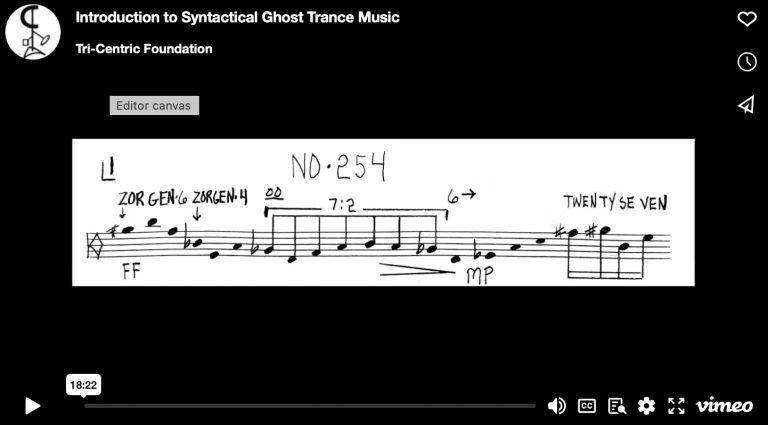
Then there’s the secondary material, which are compositions we can jump into from the primary territory. As I understand it, once a Braxton composition is performed in its original state for the purpose of being recorded, and once the recording is in the can, that composition is said to have an “origin” recording after which it becomes ready to be incorporated into other compositions as secondary material. Like a rite of passage. Because Braxton compositions continue to change shape after they’re written. The first time I performed with the trio in 2014, we used parts of Ghost Trance Music (from here on, abbreviated as GTM, and great notes regarding this system by James Fei here) and his duo compositions as the secondary material. Later, we used parts of opera Trilium E and J.
As for Anthony’s operas, Seth Colter Walls wrote a wonderful and informative article a few years back entitled Blasting Opera Forward. Of the 12 operas in the Trillium cycle, Anthony has completed six of which five have been performed, is currently working on his seventh, and has the framework for the rest. Each opera takes years to complete.
Here again, his musical systems work together. In one scene of Trillium J performed in 2014, I was part of the choir singing GTM on the balcony accompanying the double dutchers below (listen to the Syntactical GTM Choir here, similar to the GTM choir in the opera). It occurred to me then that, perhaps, when Anthony created GTM back in the mid-90s, he purposefully developed a flexible system which could be incorporated in his new works decades later. GTM is also used in his recent gorgeous interdisciplinary system Pinetop Aerial which fuses movement logics with music (watch it here with beautiful vocalist Anne Rhodes) where the vocal syllables of GTM function as cues for movement. Inversely, opera and other compositions can become the secondary material for GTM, with surprising and dramatic results.
I can’t help but wonder if Anthony composes knowing how his musical systems would be used in the future, if there is “future composer Braxton” constantly informing “present-day composer Braxton”. When most people talk about the big picture, it’s usually in the present. Anthony’s big picture, to me, always seems to contain a perspective from the future. Perhaps he is the quintessential time-manipulating artist. Or maybe he’s just great at planning ahead. I don’t really know. But I am in awe. Having a perspective from the future would certainly be useful to us improvisers, spontaneous composers who must travel ahead in time to see the whole picture because we can never go back and edit our compositions. Maybe we’re already doing it. Wouldn’t that be something. (Writer Stuart Broomer, in his recent wonderful review of Echo Echo, also mentions how Braxton’s music affects the listener‘s sense of time.)