How Do We Find Music? (2025 version)
(This is Part II of the three-part series on music discovery. Part I is How Do We Find Music? and Part III is How Do We Find Music? (Outside of the U.S. version).)
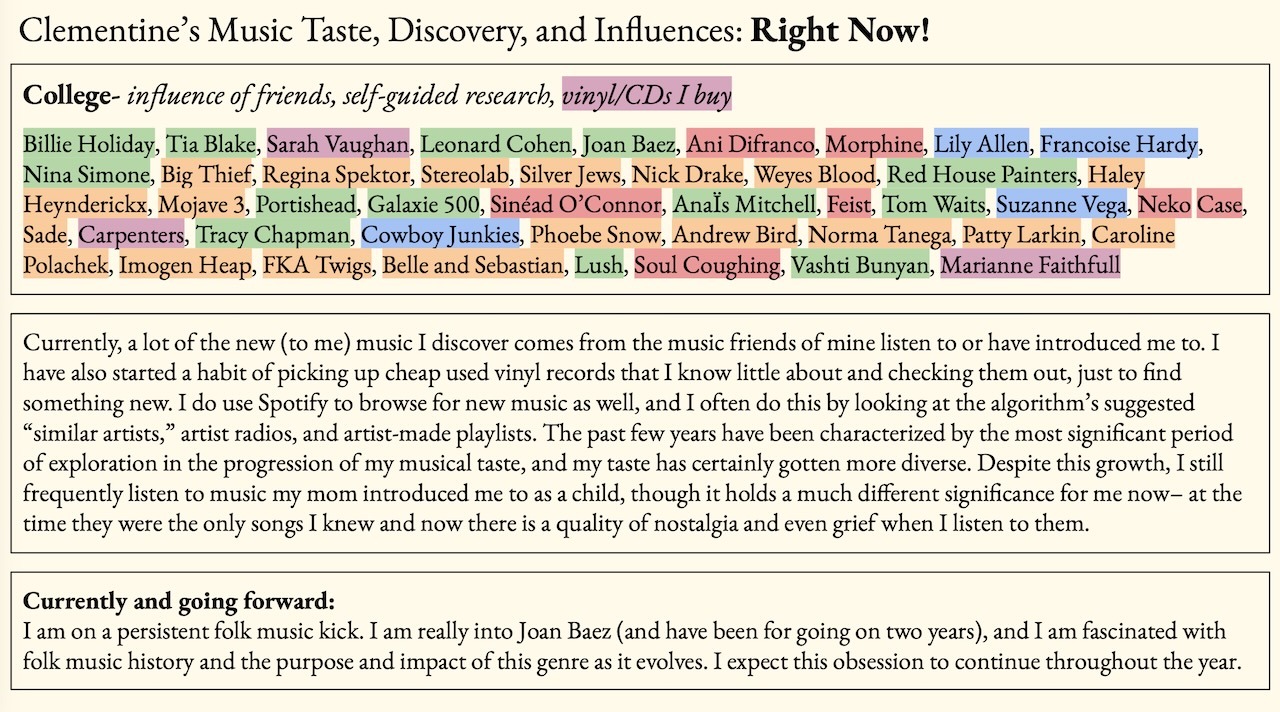
Every year in my Musical Taste and Monetization class, we trace the evolution of our listening habits, observing ourselves and becoming more aware of our influences. Clementine’s wonderful chart (at bottom) outlines our musical discovery methods. Once again, it’s people, not algorithms.
This year was different in a few very significant ways compared to last year.
- A third of the class said that they never purchase music. The students all subscribed to a platform and still bought artist merch. Compare that to the previous years when almost all the students bought some form of media: vinyls, cassettes, CDs, downloads, even 8-track tapes. This is very much in line with RIAA’s database showing that music purchases combined had been steadily declining, currently at around 13% of U.S. recorded music revenue (inflation adjusted), although 2024 did see a modest uptick in LP and EP sales.1 Downloads have been shrinking precipitously: “Revenues from digitally downloaded music continued to decline in 2023, down 18% to $336 million. Both digital album sales and individual track sales were down double digits. Downloads accounted for just 2% of US recorded music revenues in 2024, down from a peak of 43% of revenues in 2012” (from RIAA’s 2024 Year-End Revenue Report). 2 Although Bandcamp has been the rare outlier capitalizing on its direct-to-fan model, a faster shift from DLs to merch may be something for all artists to consider. Many purchases on Bandcamp are already symbolic, signifying their “purchase to support” model. It doesn’t have to be DLs. Ownership is felt stronger when consumers can touch the product.3 DLs have always been ambiguous in that sense.
- iPhone + Spotify combination ruled.
- Apple Music saw a slight comeback. The reason? Apple Music occasionally carried tracks Spotify did not, e.g., Joanna Newsom’s “Have One on Me“.
- Tumblr also saw a comeback. (Students tried to explain to me how they engage with Tumblr, something to do with fandom and community, but the generation gap was real and I could not overcome it. Meaning, I did not understand anything and just felt very old.)
- Some students were very aware of the effects of geography on the genres of music they were exposed to. Perhaps this was because we had a great international student-performer in class, or that students were generally more aware of different lifestyles and cultures associated with geographical regions, even within the U.S.
- Live music attendance remained strong. Students reported going to many concerts. Student-musicians reported creating their own performance opportunities at DIY venues.
- Discontinuation of the iPod was strongly felt. When I first started this course back in February 2022, many students would tell me about the passing down of an iPod from an elder family member as the foundation of their musical taste. A rite of passage. iPod was discontinued in May 2022. This year, I heard much less about the iPod. This felt huge, and also related to young people generally not purchasing music anymore, including downloads. Even if I give my phone to a family member, they’ll just log in to their Spotify account. Sharing music is now through Spotify playlists, not downloads or MP3s on iPods.
- None of the students had heard of Napster.
- Radio played a significant role in shaping the musical tastes of many students, but its use declined sharply as students got older. Radio seemed to be a staple for many family car trips. It’s ironic that the U.S. does not pay royalties to performers when their songs are played on US terrestrial radio stations, and now its heyday may have passed.
- Class Spotify playlist is here (minus the tracks not available on Spotify). Catalogue music played a huge role.
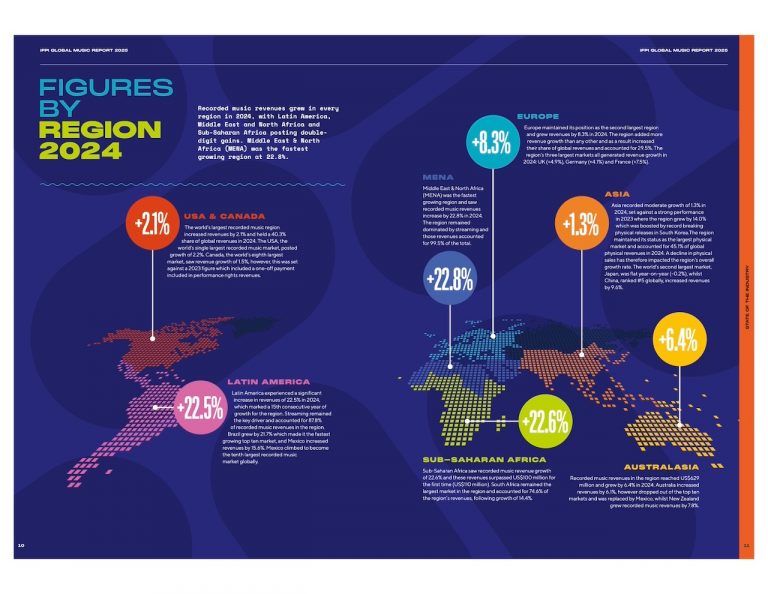
It’s important to note that this is just a very small sample of how college-age students engage with recorded music today. Global recorded music revenue growth in 2024 was led by Latin America (+22.5%), the Middle East and North Africa (+22.8%), and Sub-Saharan Africa (+22.6%) and, importantly, not by the U.S. whose market is already saturated.4 China, of course, has a highly developed music streaming system outside of the conventional Western Spotify/Apple model.5 Eyes are on the non-Western world, and have been for a while. All that said, if my past years of this course tell me anything, it will always be people over algorithms, and these students once again confirmed that feeling. They are creating their own opportunities, often in ways which my generation may not be aware of. I continue to learn from them. Who is teaching whom? Students are our future. Huge thank you to Bennington College for having me be a part of their program from 2022 to 2025. To the students graduating, congratulations! And to all the students: keep questioning the status quo and think globally.
- U.S. Music Revenue Database – RIAA. (2025, May 20). RIAA. https://www.riaa.com/u-s-sales-database/ ↩︎
- Downloadable PDF here: https://www.riaa.com/wp-content/uploads/2025/03/RIAA-2024Year-End-Revenue-Report.pdf ↩︎
- Peck, J., & Shu, S. B. (2009). The effect of mere touch on perceived ownership. Journal of Consumer Research, 36(3), 434–447. https://doi.org/10.1086/598614 ↩︎
- Stassen, M., & Stassen, M. (2025, March 20). Global recorded music revenues hit $29.6bn in 2024, up 4.8% YoY; users of paid music subscriptions reach 752m. Music Business Worldwide. https://www.musicbusinessworldwide.com/global-recorded-music-revenues-hit-29-6bn-in-2024-up-4-8-yoy-users-of-paid-music-subscriptions-reach-752m/ ↩︎
- Dalugdug, M., & Dalugdug, M. (2025, March 18). Tencent Music now generates over $2bn from music streaming subscriptions annually. Music Business Worldwide. https://www.musicbusinessworldwide.com/tencent-music-now-generates-over-2b-from-music-streaming-subscriptions-annually/ ↩︎